
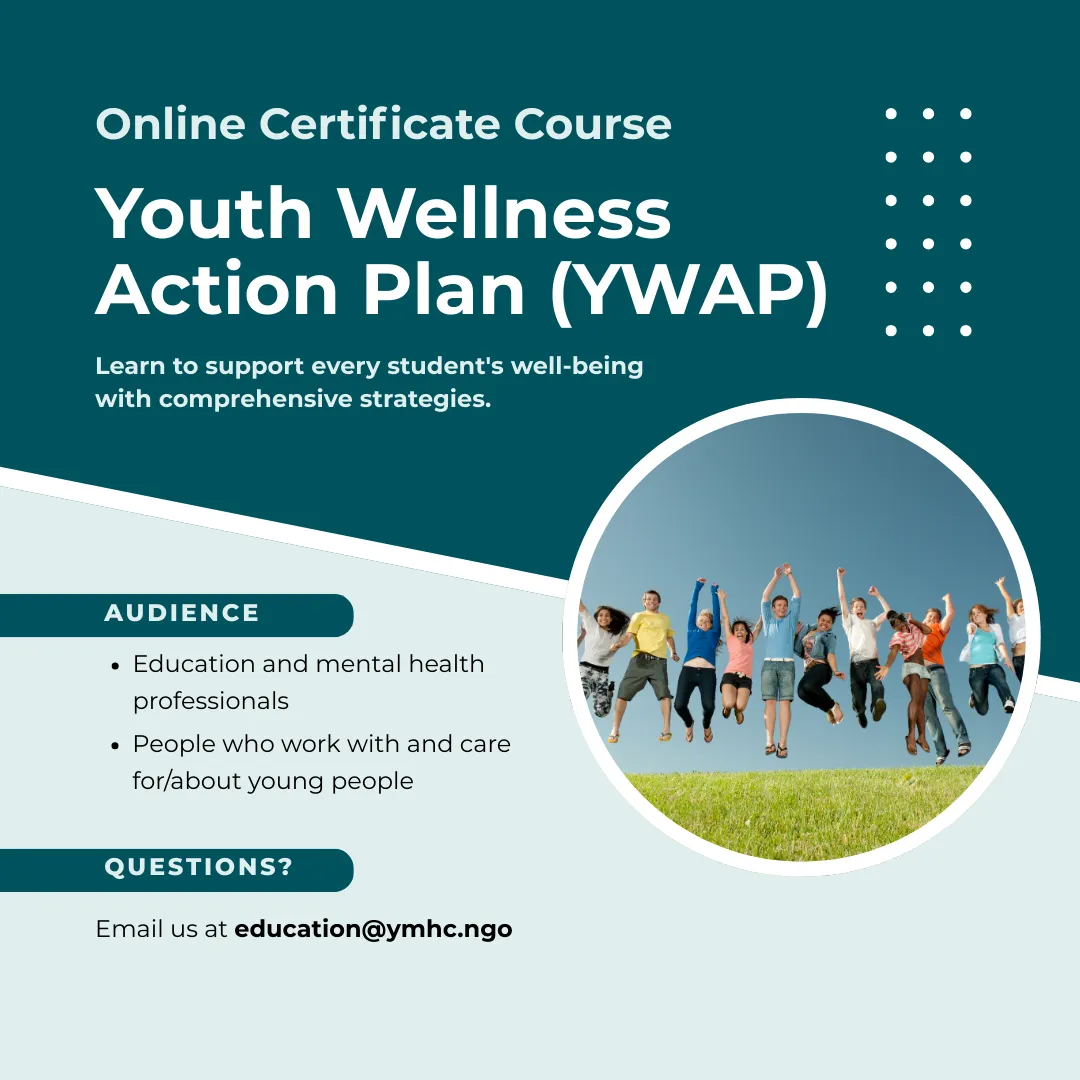
Online Certificate Course: Youth Wellness Action Plan (YWAP), Second Edition
Learn to support every student's well-being with comprehensive strategies. The Youth Wellness Action Plan course places mental health literacy, planning tools, coping skills, and clear information about available supports directly into the hands of young people and the adults who work with them.
What is included
Online Certificate Course (10 modules, 100 lessons)
An on-demand video course with 10 quiz topics. Participants receive a certificate of completion after finishing the course requirements.
Mental Wellness Action Plan booklet
A practical, strength-based activities booklet with a printable license for unlimited copies and easy-to-use checklists, which can be kept in a safe place, shared with trusted adults, and updated as students learn what helps them maintain their well-being.
Lived-experience video testimonials
A dedicated module in which youth speak directly about their own mental health and wellness journeys.
Course Introduction
Young people today are experiencing complex pressures, and research indicates that youth mental health and well-being is at risk around the world. In Canada, an estimated 1.2 million youth require mental health support, yet 57% do not get the help they need. Suicide remains the number one health-related cause of death among young people, and awareness of supports such as Canada's 9-8-8 Suicide Crisis Helpline remains low.
The YWAP course responds to the challenges, pressures, and demands young people face by placing mental health literacy, planning tools, coping skills, and clear information about available supports directly into the hands of young people and the adults who work with them.
Rather than waiting for a crisis, YWAP takes a proactive, universal approach. The Youth Wellness Action Plan assumes that all young people are at risk of a mental health crisis at some point in their lives, and it prepares them, and the adults around them, well before that point. A Youth Wellness Action Plan (YWAP) is a personalized, living tool for wellness that empowers individuals to act when they are struggling with their mental health, and it is meant to be regularly reviewed and updated, not produced once and forgotten.
The ASAP Model
Awareness
Help students recognize their needs.
Support
Identify their supports.
Action
Build practical coping strategies.
Prevention
Plan ahead for challenges before they become overwhelming.
At the heart of the course is the ASAP Model, which organizes a Youth Wellness Action Plan around four connected areas: Awareness, Support, Action, and Prevention. Participants use this framework throughout the course to help students recognize their needs, identify their supports, build practical coping strategies, and plan ahead for challenges before they become overwhelming.
Course Highlights
- Developed and delivered by Sheryl Boswell, an educator who has taught elementary, secondary, postsecondary, and adult education students in Canada and Africa, and who has delivered workshops across Canada and internationally on universal student support strategies and wellness action plans.
- Grounded in the ASAP Model (Awareness, Support, Action, and Prevention), a practical framework for building a Youth Wellness Action Plan.
- Built on international best practices in mental health and wellness, including the Wellness Recovery Action Plan (WRAP, developed in 1997 in the United States), Wellness Action Plans (WAPs) used in United Kingdom workplaces, and Universal Safety Planning for Suicide Prevention (CODE RED, United States).
- Includes a practical, strength-based activities booklet with a printable license for unlimited copies and easy-to-use checklists, which can be kept in a safe place, shared with trusted adults, and updated as students learn what helps them maintain their well-being.
- Spans 10 modules covering language and terminology, diversity and lived experience, self-, brain-, and stress-awareness, support systems, coping and action skills, and prevention strategies.
- Includes a dedicated module of lived-experience video testimonials, in which youth speak directly about their own mental health and wellness journeys.
- Each module closes with a quiz activity so participants can review the key ideas and identify what they want to carry forward.
- Built around strength-focused, evidence-based, and trauma-informed practices that create a foundation for supportive classroom environments where every student can thrive.
- Supports a Wellness Action Plan that strengthens problem-solving skills, supports academic success, promotes healthy lifestyle habits, enhances self-confidence and self-awareness, encourages early intervention, builds resilience, improves emotional regulation, supports positive decision-making, reduces stress and anxiety, increases help-seeking confidence, builds strong support networks, develops healthy coping strategies, and improves communication skills.
Course Outline: 10 Modules, 100 Lessons
- Module 1 — Introduction
15 lessons
- Land Acknowledgement and Commitment
- Introduction with Elder John Rice
- About YMHC
- YWAP Glossary of Terms
- Mental Wellness Action Plan booklet download
- An Introduction to the YWAP Course
- Course Overview
- The ASAP Model
- An Introduction to YWAP
- A Youth Mental Health Crisis
- Mental Health Education Saves Lives
- About the YWAP Course
- Course Objectives and Outcomes
- Module 1 References
- Module 1 Quiz
- Module 2 — Language Matters
10 lessons
- Language Matters Introduction
- Defining Mental Health
- Defining Mental Wellness
- Protective and Risk Factors
- Mental Health Disorders
- Language Types
- Disability Awareness
- Life Promotion and Suicide Prevention
- Module 2 References
- Module 2 Quiz
- Module 3 — Lived Experience: Youth Speak about Mental Wellness
8 lessons
- Youth Speak About Mental Wellness
- Defining Mental Health & Mental Wellness with Kristen
- Mental Health Journey with Tialynn
- Defining Mental Wellness with Colin
- Jack Linklater Jr: Indigenous Wellness
- Male Mental Health with Colin
- Lived Experiences and Mental Health with Colin
- Module 3 Quiz
- Module 4 — Diversity Awareness
12 lessons
- Diversity Awareness Introduction
- Black Mental Health
- Cultural Identity
- LGBTQIA2S+ Wellness
- Disability & Inclusion
- Indigenous Wellness
- Male Mental Health
- Female Mental Health
- Newcomer Mental Health
- Asian Mental Health
- Module 4 References
- Module 4 Quiz
- Module 5 — Awareness
15 lessons
- Awareness Introduction
- Youth Mental Health Awareness
- Emotional Awareness
- Self-Awareness
- Thought Awareness
- Purpose and Meaning
- Learning Style Awareness
- Module 5 References
- Module 5 Quiz
- Awareness
- Emotional Awareness
- Thought Awareness
- Learning Awareness
- Coping Strategies
- Brain Awareness
- Module 6 — Brain Awareness
6 lessons
- Brain Awareness Introduction
- How the Brain Works
- The Brain in Action
- The Adolescent Brain
- Module 6 References
- Module 6 Quiz
- Module 7 — Stress Awareness
6 lessons
- Stress Awareness Introduction
- What is Stress?
- Student Stressors
- Stress Responses
- Module 7 References
- Module 7 Quiz
- Module 8 — Support Systems
11 lessons
- Support Systems Introduction
- Trusted Adults
- School Support
- The Education Support Team
- School Safety
- Community Support
- Help-Seeking Skills
- Peer Support
- Parent/Caregiver Support
- Module 8 References
- Module 8 Quiz
- Module 9 — Action
9 lessons
- Action Introduction
- Coping Skills
- Self-Care Strategies
- Distraction Strategies
- Resiliency and Agility
- Problem-Solving Skills
- Stress Management
- Module 9 References
- Module 9 Quiz
- Module 10 — Prevention
8 lessons
- Prevention Introduction
- Prevention
- Healthy Habits
- Caring Connections
- Digital Wellness
- Mentally Healthy Schools
- Module 10 References
- Module 10 Quiz
Who This Course Is For
This course is designed for educators, school staff, mental health professionals, parents, caregivers, and others supporting young people. It is a transformative course designed for education and mental health professionals seeking practical, school-wide strategies for student well-being.
The YWAP can be presented to students effectively by teachers, community or youth workers, or mental health professionals, making it accessible for widespread implementation in various settings. No specialized training in mental health is required, allowing more individuals to benefit from wellness action planning and enabling schools and communities to equip more young people with the tools they need to support themselves and others.
I genuinely love how real and personal the course feels. Even the rawness of the audio and the squeaky chair in the background! It made me feel like I was sitting in a room with someone who genuinely cares about what they are teaching. The more I worked through the course, the more I learned about myself. It helped me understand how environments, Adverse Child Experiences (ACE), relationships, and support systems can shape our overall mental capacity. It allowed me to connect pieces of myself and stop always wondering if I was the problem. You may begin this course thinking you are simply learning about youth mental health, but somewhere along the way, you may learn something about yourself too. Thank you, Sheryl & YMHC, for all the work, time, and heart put into this course. I truly think it is brilliant!
Created by Sheryl Boswell & YMHC Charitable Foundation
Sheryl Boswell is an educator, the Executive Director and Founder of Youth Mental Health Canada, Career Counselor and Life Skills Coach, whose work in school attendance challenges spans more than three decades. She began as the Stay-in-School Coordinator for an innovative Toronto-based program, and has since trained thousands of educators, counselors, and school leaders across Canada and internationally. She is an active member of the International Network for School Attendance, the American Association of Suicidology, and the International Association of Youth Mental Health.
Youth Mental Health Canada (YMHC) is a grassroots, community-based charitable nonprofit operating through a social justice, human rights, and educational equity lens. YMHC is not government-funded — every course purchase directly supports accessible mental health education for young people and families across Canada. The 2025 and 2026 YMHC National Conferences on School Attendance Challenges drew over 460 participants and featured presenters from Canada, the United States, United Kingdom, Netherlands, Germany, Chile, Australia, and New Zealand.
Need Help?
We are here to help.