


Youth Mental Health Canada
Handbook on School Attendance Challenges: Addressing Barriers to Education with Tiered School-Wide Strategies - Photocopiable License
Handbook on School Attendance Challenges: Addressing Barriers to Education with Tiered School-Wide Strategies - Photocopiable License
Impossible de charger la disponibilité du service de retrait
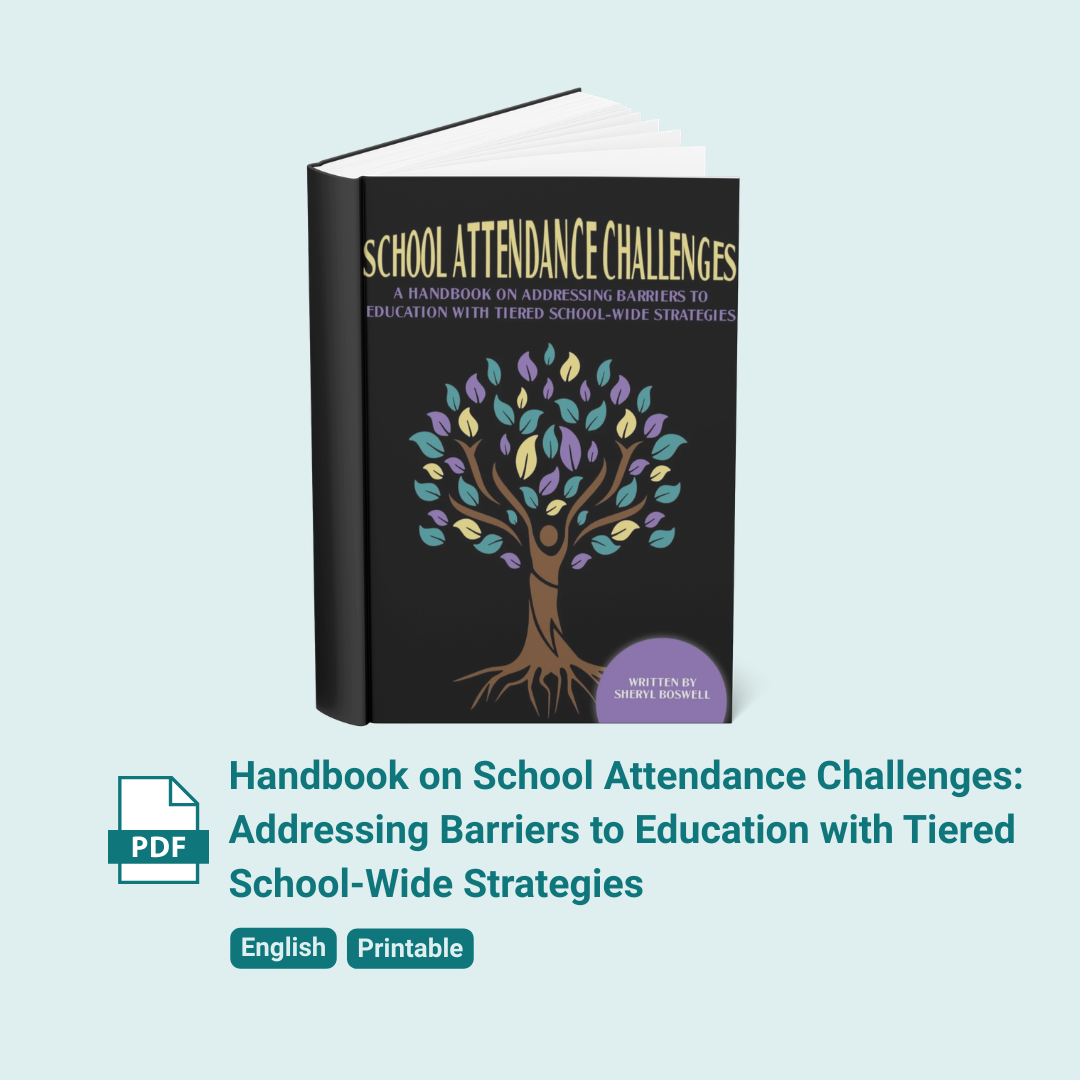
A practical, implementation-focused handbook designed to help schools move from reactive and punitive attendance responses to compassionate, structured, and evidence-informed support systems.
This handbook provides the tools, frameworks, and actionable strategies needed to understand and respond to school attendance challenges through a tiered, whole-school approach grounded in inclusion, mental health, trauma, and disability awareness, and student well-being.
Information:

Across Canada and around the world, educators, families, and communities are facing an urgent and growing challenge: increasing numbers of students are struggling to access and remain connected to education. What is often labelled as absenteeism, truancy, or school refusal is rarely a simple issue of behaviour or motivation. More often, it reflects complex barriers related to mental health, disability, neurodiversity, trauma, and systemic inequities within education systems.
This handbook was created in response to those realities.
In my work on school attendance and engagement and student mental health and wellness over more than thirty years, the conversations with families, educators, mental health professionals, and young people I have had revealed a consistent message: many students want to learn and want to be part of their school community, but the systems designed to support them are not always structured to meet their needs. When educational environments do not recognize or accommodate diverse experiences of learning, health, and well-being, barriers emerge that can make attending school overwhelming, unsafe, or simply impossible for some students.
School attendance challenges are therefore not merely attendance issues—they are indicators of unmet needs and barriers within the broader educational ecosystem. They signal the need for compassionate, collaborative, and systemic responses that move beyond punitive approaches and toward understanding, support, and inclusion.
This handbook was written to support that shift.
It offers educators, school leaders, families, and community partners a framework for understanding school attendance challenges through a lens of student well-being, school protective factors, suicide prevention, disability inclusion, educational equity, and social justice. It emphasizes the importance of recognizing students’ lived experiences and identifying the environmental, relational, and systemic factors that influence whether a young person can safely access and engage in education.
At the heart of the book is a practical approach: tiered school-wide strategies that help schools move from reactive responses to proactive systems of support. Drawing on Multi-Tiered Systems of Support (MTSS), trauma-informed practices, and protective-factor frameworks, the handbook presents strategies that operate across three levels:
-
Universal supports (Tier 1) that promote safety, belonging, and well-being for all students.
-
Targeted supports (Tier 2) for students showing early signs of difficulty with attendance or engagement.
-
Intensive support (Tier 3) for students experiencing significant or ongoing barriers to accessing education.
Together, these tiers create a flexible continuum of support that recognizes students’ needs as dynamic rather than fixed.
Equally important, this handbook emphasizes the power of collaboration. Addressing school attendance challenges requires the shared efforts of educators, families, students, and community professionals. Families are not peripheral to this process—they are essential partners whose knowledge and lived experience provide crucial insights into the barriers their children face.
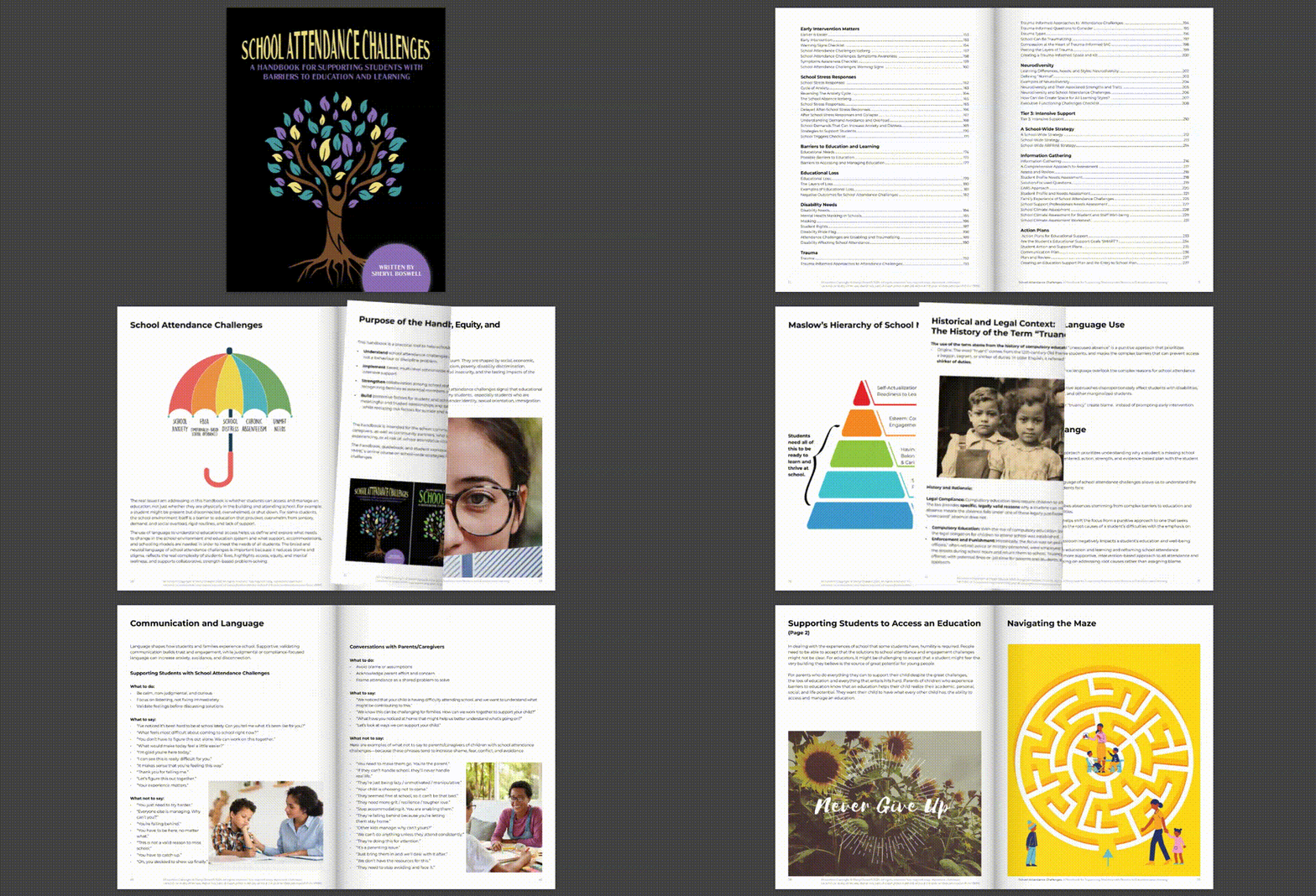
Throughout this book, readers will find practical tools to support that collaborative work, including checklists, reflection exercises, action plans, and structured conversation guides. These resources are designed to help schools identify barriers, build protective factors, and develop responsive support plans that prioritize student well-being, dignity, and educational access.
Underlying every page of this handbook is a simple but powerful belief:
Education should be individualized, accessible, inclusive, and supportive for every student.
When schools focus on belonging, compassion, and flexibility, they become places where students feel valued and safe enough to learn. When educators listen deeply to students and families, they uncover insights that transform practice. And when school communities work together to remove barriers to education, they create pathways not only to academic success but also to well-being, resilience, and hope.
This handbook is an invitation—to reflect, to rethink, and to act.
It invites educators to look beyond attendance data and ask deeper questions about access, safety, and belonging. It invites school systems to reconsider policies and practices that may unintentionally exclude vulnerable learners. And it invites all of us—educators, families, policymakers, and community members—to work together to build educational environments where every young person has the opportunity to participate, connect, and thrive.
Ultimately, the goal is not simply to increase attendance.
The goal is to create schools where students feel supported, understood, and ready to learn.
When we achieve that, attendance follows naturally—because students are no longer being asked to fit into systems that do not meet their needs. Instead, the system is working to meet them where they are.
And that is where meaningful, inclusive education begins.
Delivery Information: You will receive the photocopiable license as a PDF file through email. Please note that this is a digital item and not a tangible product.
Comparaison de différents formats de classeur


Conditions de licence numérique photocopiable
Autorisation de photocopier pour une seule école/adresse d'achat – Les photocopies sont destinées au personnel de l'école primaire ou secondaire à l'adresse d'achat. Si vous avez 5 adresses, vous devrez acheter 5 livres.
Nous n'autorisons pas les conseils scolaires à desservir plus d'une école à partir d'un seul livre.
Nous n'autorisons personne à photocopier une photocopie des livres.
Les copies électroniques du contenu ne peuvent pas être publiées ou distribuées par des fournisseurs de cours tiers, des agrégateurs/distributeurs de contenu ou toute autre plateforme.
Nous n’accordons aucune autorisation pour toute adaptation, modification, extrait ou résumé de tout produit.
Nous n'effectuons pas de remboursement pour les produits numériques une fois la commande confirmée et le produit envoyé.
Play Fair – Respectez les droits d’auteur !

Restrictions de droits d'auteur sur les licences photocopiables
Le YMHC propose du matériel photocopieable avec des lignes directrices spécifiques pour faciliter son utilisation au sein des établissements d'enseignement :
- Bien que ces cahiers d'exercices et guides soient envoyés sous forme numérique au format PDF, ils sont conçus pour être imprimés et photocopiés pour être utilisés au sein de l'établissement d'enseignement acheteur.
- L'autorisation de photocopie est spécifiquement accordée au personnel de l'école acheteuse à l'adresse indiquée, leur permettant de distribuer des copies à leurs collègues et étudiants au sein de la même école.
- Si plusieurs écoles ou adresses souhaitent utiliser ces documents, chacune doit acquérir sa propre copie pour garantir une utilisation équitable et le respect des lois sur le droit d'auteur.
- Il est important de noter que ces documents ne doivent pas être dupliqués au-delà de la portée initiale de l'impression et de la photocopie pour laquelle ils sont autorisés. Par exemple, il est interdit de photocopier une photocopie déjà réalisée ou d'étendre la distribution au-delà du site d'achat.
- De même, ces documents photocopiables ne peuvent être partagés électroniquement sur des plateformes tierces ou par des agrégateurs de contenu, préservant ainsi l'exclusivité du contenu pour l'usage de l'acheteur.
- Toute forme de modification ou d'adaptation du contenu est strictement interdite afin de préserver la qualité pédagogique et les droits d'auteur du matériel.