

Ir directamente a la información del producto
1 de 1

YMH Consulting

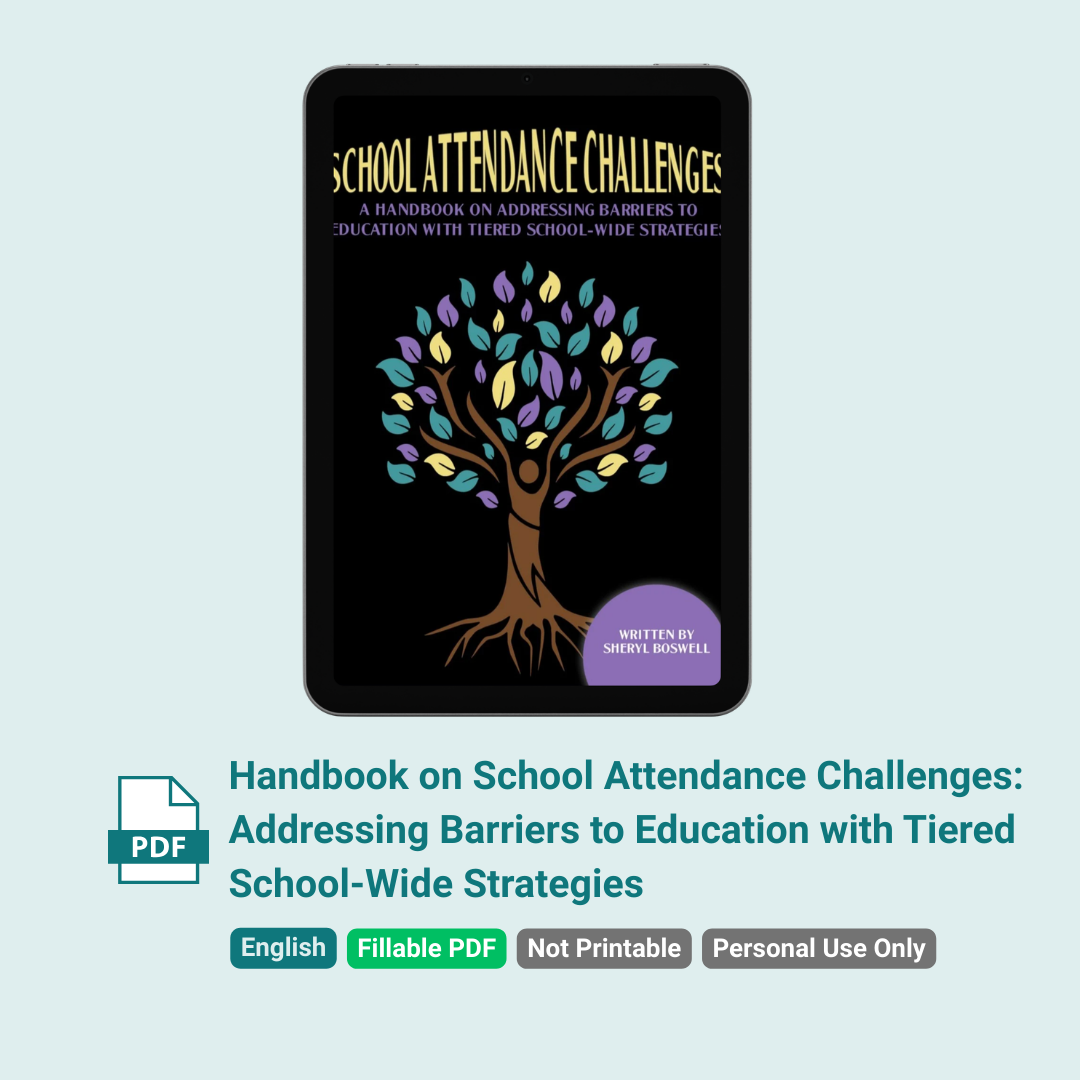
[PRE-ORDER] Handbook on School Attendance Challenges: Addressing Barriers to Education with Tiered School-Wide Strategies (Digital Fillable) - Personal License

[PRE-ORDER] Handbook on School Attendance Challenges: Addressing Barriers to Education with Tiered School-Wide Strategies (Digital Fillable) - Personal License

Precio habitual $75.00 CAD
Precio habitual Precio de oferta $75.00 CAD
Oferta Agotado
Los gastos de envío se calculan en la pantalla de pago.
Cantidad

Across Canada and around the world, educators, families, and communities are facing an urgent and growing challenge: increasing numbers of students are struggling to access and remain connected to education. What is often labelled as absenteeism, truancy, or school refusal is rarely a simple issue of behaviour or motivation. More often, it reflects complex barriers related to mental health, disability, neurodiversity, trauma, and systemic inequities within education systems.

This handbook was created in response to those realities.

In my work on school attendance and engagement and student mental health and wellness over more than thirty years, the conversations with families, educators, mental health professionals, and young people I  have had revealed a consistent message: many students want to learn and want to be part of their school community, but the systems designed to support them are not always structured to meet their needs. When educational environments do not recognize or accommodate diverse experiences of learning, health, and well-being, barriers emerge that can make attending school overwhelming, unsafe, or simply impossible for some students.

School attendance challenges are therefore not merely attendance issues—they are indicators of unmet needs and barriers within the broader educational ecosystem. They signal the need for compassionate, collaborative, and systemic responses that move beyond punitive approaches and toward understanding, support, and inclusion.

This handbook was written to support that shift.

It offers educators, school leaders, families, and community partners a framework for understanding school attendance challenges through a lens of student well-being, school protective factors, suicide prevention, disability inclusion, educational equity, and social justice. It emphasizes the importance of recognizing students’ lived experiences and identifying the environmental, relational, and systemic factors that influence whether a young person can safely access and engage in education.

At the heart of the book is a practical approach: tiered school-wide strategies that help schools move from reactive responses to proactive systems of support. Drawing on Multi-Tiered Systems of Support (MTSS), trauma-informed practices, and protective-factor frameworks, the handbook presents strategies that operate across three levels:

  • Universal supports (Tier 1) that promote safety, belonging, and well-being for all students.

  • Targeted supports (Tier 2) for students showing early signs of difficulty with attendance or engagement.

  • Intensive support (Tier 3) for students experiencing significant or ongoing barriers to accessing education.

Together, these tiers create a flexible continuum of support that recognizes students’ needs as dynamic rather than fixed.

Equally important, this handbook emphasizes the power of collaboration. Addressing school attendance challenges requires the shared efforts of educators, families, students, and community professionals. Families are not peripheral to this process—they are essential partners whose knowledge and lived experience provide crucial insights into the barriers their children face.

Throughout this book, readers will find practical tools to support that collaborative work, including checklists, reflection exercises, action plans, and structured conversation guides. These resources are designed to help schools identify barriers, build protective factors, and develop responsive support plans that prioritize student well-being, dignity, and educational access.

Underlying every page of this handbook is a simple but powerful belief:
Education should be individualized, accessible, inclusive, and supportive for every student.

When schools focus on belonging, compassion, and flexibility, they become places where students feel valued and safe enough to learn. When educators listen deeply to students and families, they uncover insights that transform practice. And when school communities work together to remove barriers to education, they create pathways not only to academic success but also to well-being, resilience, and hope.

This handbook is an invitation—to reflect, to rethink, and to act.

It invites educators to look beyond attendance data and ask deeper questions about access, safety, and belonging. It invites school systems to reconsider policies and practices that may unintentionally exclude vulnerable learners. And it invites all of us—educators, families, policymakers, and community members—to work together to build educational environments where every young person has the opportunity to participate, connect, and thrive.

Ultimately, the goal is not simply to increase attendance.

The goal is to create schools where students feel supported, understood, and ready to learn.

When we achieve that, attendance follows naturally—because students are no longer being asked to fit into systems that do not meet their needs. Instead, the system is working to meet them where they are.

And that is where meaningful, inclusive education begins.

Delivery Information: You will receive the photocopiable license as a PDF file through email. Please note that this is a digital item and not a tangible product.

Ver todos los detalles

Cuaderno digital interactivo rellenable

Condiciones de la licencia personal

Cada Licencia de Distribución sólo permite 1 copia de distribución electrónica. Queda prohibida la fotocopia o cualquier redistribución impresa.

Por ejemplo, si desea utilizar 5 copias digitales para 5 estudiantes, deberá adquirir 5 Licencias de Distribución.

Si pretende utilizar estos materiales con fines comerciales, como en un aula o en un entorno de práctica profesional, deberá obtener una Licencia Fotocopiable. Para obtener más información o ayuda para adquirir una licencia fotocopiable, consulte la categoría "Licencia fotocopiable" o póngase en contacto con admin(at)youthmentalhealth.ca.

Todo el contenido de SMJC está protegido por derechos de autor y no se puede reproducir ni distribuir, ya sea en forma impresa o electrónica, sin una licencia de distribución adecuada de SMJC.

Las copias electrónicas de los contenidos no pueden ser publicadas ni distribuidas por terceros proveedores de cursos, agregadores/distribuidores de contenidos o cualquier plataforma.

No concedemos permiso para ninguna adaptación, edición, extracto o resumen de ningún producto.

No realizamos reembolsos de productos digitales una vez que el pedido ha sido confirmado y el producto ha sido enviado.

Los productos digitales están protegidos por derechos de autor.

Restricciones a los derechos de autor de los cuadernos y guías digitales (Licencia personal)

Los recursos digitales de SMJC están diseñados para ser cómodos y accesibles, permitiéndole interactuar con el contenido en dispositivos electrónicos:

  • Los libros de trabajo y guías digitales no pueden imprimirse, fotocopiarse ni compartirse digitalmente.
  • Se proporcionan normalmente en formato PDF, y algunos pueden rellenarse para mejorar la interactividad.
  • Cada Licencia de Distribución permite una única copia de distribución electrónica. Si necesita distribuir copias digitales a varios lectores, deberá adquirir el número correspondiente de Licencias de distribución.
  • Está estrictamente prohibido publicar o distribuir estas copias electrónicas en plataformas de terceros o mediante agregadores de contenidos.
  • SMJC no permite ninguna modificación, incluidas adaptaciones, ediciones, extractos o resúmenes, de sus productos digitales.
.